
Venango County Criminal Court Cases
The Venango County Court of Common Pleas is Pennsylvania's 28th Judicial District. It hears felony and misdemeanor matters after an issuing authority holds charges for court. The county's Court Administration page supplies the local judicial contact. Pennsylvania's court statistics identify two Common Pleas judgeships in the county. Before that point, a Magisterial District Judge handles the complaint, preliminary arraignment, bail, and preliminary hearing. An MDJ also finally decides many summary and traffic matters.
The active Venango County districts identified in the research are 28-3-01, 28-3-03, and 28-3-04. Their listed phone numbers are 814-670-0339, 814-432-3621, and 814-676-5421. District boundaries and office sites can change, so confirm the live address in the UJS directory before a visit. Once a Venango County case reaches Common Pleas, its number uses the county code CP-61, a criminal-case sequence, and the filing year.
Inside Venango County Court Records
The Prothonotary and Clerk of Courts is the Common Pleas criminal custodian. The Venango County office sits on the first floor of the courthouse, 1168 Liberty Street, Franklin, PA 16323. Public hours are 8:30 a.m. to 4:30 p.m. on weekdays except legal holidays, and the phone is 814-432-9577. Call with a docket number when seeking a certified copy, an older file, an exhibit, or a paper not available online.
The clerk's duties reach beyond a simple docket index. The office keeps ARD files, hearing and trial minutes, exhibits, bail-bond money, fines, forfeited bonds, juvenile files, and the court seal. Access still depends on the record. Juvenile custody does not make a juvenile file public, and protected filings remain restricted.
The Venango County official Clerk of Courts page shows the office and its current public contact details.
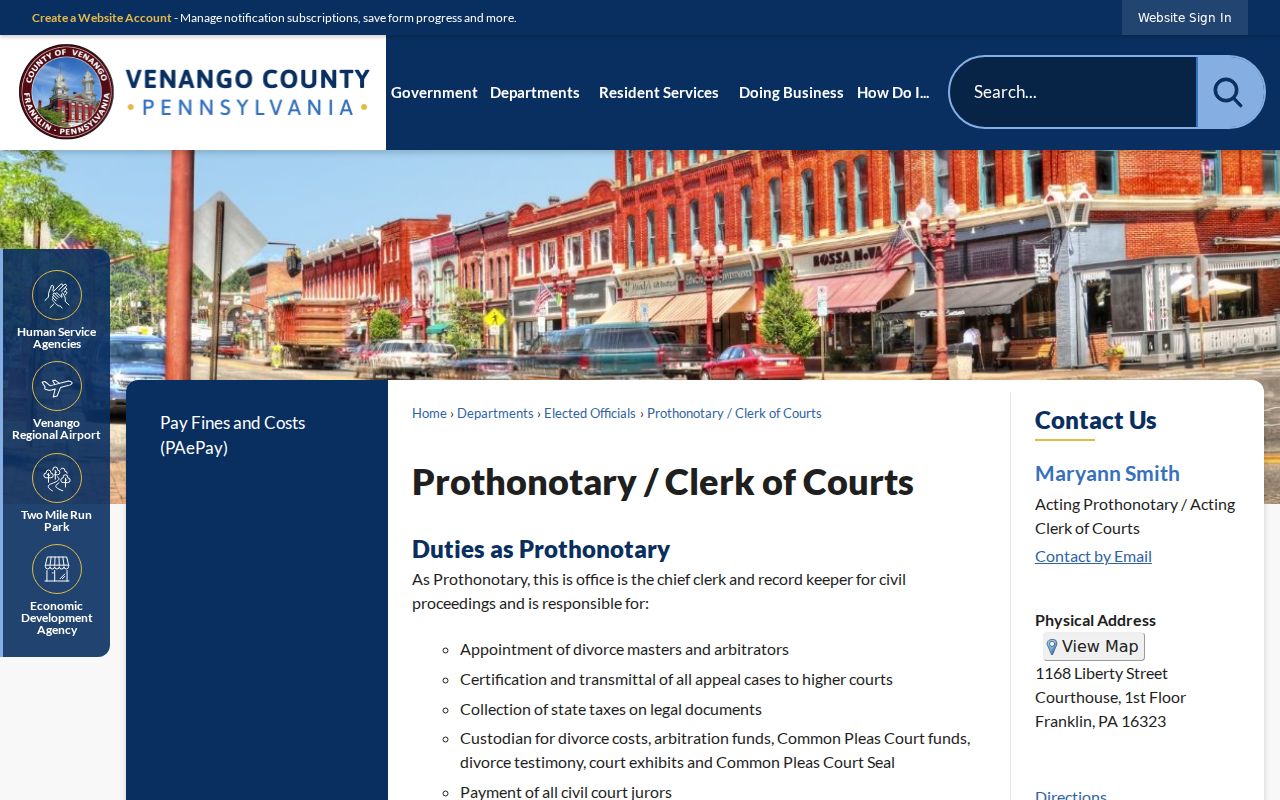
That Venango County office confirms what exists beyond the public docket sheet and provides current copy or certification charges.
Searching Venango County Case Records
The free Unified Judicial System Web Portal is the first Venango County search channel for both Common Pleas and MDJ dockets. Search Venango County dockets broadly for discovery, then confirm identity through the OTN, filing date, initiating court, arresting agency, and charge facts. A same-name match is not enough. CAPTCHA or session controls may apply, and a public docket may omit sealed material or protected documents.
- Choose Courts of Common Pleas for a held-for-court case, or Magisterial District Courts for an early, traffic, or summary case.
- Select Venango County and the criminal docket type.
- Search by participant name, docket number, or OTN, adding a filing range when useful.
- Open the docket and verify the identity, charges, bail, proceedings, and count-level dispositions.
- Record the docket number and contact the Clerk or MDJ for the full file or a certified copy.
| Field label | Type | Required | Format notes |
|---|---|---|---|
| Search Type | Tabs or radio | Yes | Participant, docket number, organization, or OTN where offered |
| Court Type | Selector | Yes | Common Pleas or Magisterial District Court |
| County | Dropdown | Yes locally | Select Venango |
| Participant Name | Text | Name route | Last name is key; first name narrows common matches |
| Docket Number | Text | Docket route | CP-61 format includes case type, sequence, and year |
| OTN | Text | Optional route | Links the charging event to the court record |
| Date Filed | Date range | No | Limits the year span |
Common Pleas and MDJ Cases
A frequent Venango County court search error is using the right name in the wrong court type. The Venango County MDJ docket is where the complaint, first arraignment, bail decision, and preliminary hearing begin. If the Commonwealth establishes a prima facie case, or the hearing is waived, the case moves to Common Pleas. The District Attorney then files a criminal information. That later filing can differ from the charges shown at arrest.
Use the initiating MDJ number and OTN to connect the two records. The Venango County Common Pleas docket often refers back to the lower-court case. If UJS returns nothing, try a broader spelling and wider filing range, check both court levels, and ask the relevant clerk about older paper material. A sealed, expunged, or limited-access matter may properly be absent from the public result. A federal matter leaves this CP-61 system and is indexed through PACER.
Note: A docket status of closed means procedure ended; only the count-level entries show whether charges led to a conviction.
Inside a Venango County Case File
A Venango County criminal case file records the court's work, not just the accusation. Its header identifies the caption, court, filing date, status, OTN, and docket number. Charge rows show the statute, grade, count, and disposition. The entry list then supplies the chronology, including formal arraignment, motions, continuances, pleas, trial events, orders, sentencing, and appeals. Bail and financial records are separate parts of the same case history.
| Identity and case | Caption, aliases, limited demographics, docket number, OTN, filing date, and status |
|---|---|
| Charges | Statute, grade, count, arresting agency, complaint date, and final disposition |
| Bail | Type, amount, posting terms, and later changes |
| Proceedings | Hearings, arraignment, pretrial events, plea or trial, and sentencing |
| Representation | Prosecutor and defense counsel appearances |
| Sentence and money | Confinement or probation terms, credit, fines, costs, and balances when shown |
The Venango County docket sheet may index a motion or order without providing its scanned text. Ask the Venango County Clerk for that document. Victim-sensitive facts, account numbers, Social Security numbers, and confidential filings are not part of ordinary public access.
Reading Venango County Court Dockets
Read each Venango County charge from left to right and follow it to its own final result. Pennsylvania's offense-grading provisions help explain felony, misdemeanor, and summary labels, but the filed docket grade is the safer case-specific field. A charge may be withdrawn, dismissed, reduced, acquitted, nolle prossed, resolved through ARD, or end in a guilty plea or finding. Nolle prosequi means the prosecution chose not to proceed on that count. ARD is a diversion result, not a conviction, but it creates a Venango County court record and may require a later expungement process.
- OTN
- The Offense Tracking Number that connects an arrest or complaint with later court reporting.
- Criminal information
- The formal charging document filed by the District Attorney after a case reaches Common Pleas.
- Disposition
- The result assigned to a charge, such as dismissed, withdrawn, guilty, or not guilty.
- Bail
- A release condition set by a judge, not a finding about guilt.
- ARD
- Accelerated Rehabilitative Disposition, a diversion path that is distinct from conviction.
How a Criminal Case Moves
An officer starts a Venango County case by filing a complaint before an MDJ. The preliminary arraignment brings the accused before the issuing authority and sets bail. At the Venango County preliminary hearing, the Commonwealth must show a prima facie case, meaning enough evidence for the charges to move forward. Held or waived charges then enter Common Pleas, where formal arraignment, discovery, motions, and pretrial work occur.
Case flow: Charges Filed → Arraignment → Pretrial → Plea or Trial → Disposition → Sentencing
A case may instead end through dismissal, withdrawal, ARD, or another diversion. The county's criminal-procedure summary describes this local route, while the Public Defender handles representation for qualifying applicants rather than record certification. After sentence, the record can include post-sentence motions and appeals. The UJS entries preserve that order even when the filings themselves must be requested at the courthouse.
Venango County Criminal Case Totals
The official 2024 UJS caseload report counted 586 new Venango County Common Pleas criminal cases. Of those, 221 were classified as felony cases and 365 as misdemeanor cases. Leading-offense groups included 146 person cases, 139 DUI cases, 136 property cases, 88 public-order cases, 61 drug cases, 11 weapon cases, and 5 other motor-vehicle cases.
Those figures count new cases by the leading offense. They do not count unique people, arrests, convictions, or crime incidents. DUI represented 23.7 percent and person offenses 24.9 percent of the new-case total, but neither share is a neighborhood crime rate. The numbers help explain clerk workload and docket volume. They should not be used to infer guilt or the outcome of any individual Venango County court record.
Problem-Solving Court Record Trail
Venango County operates a named Problem-Solving Court, and the Clerk also maintains ARD records. A diversion path can change the way a criminal matter ends, yet participation should never be guessed from a continuance or an open status. Look for a clear docket entry, order, or disposition. Court Supervision handles the local supervision side, while the Clerk keeps the filed court record.
The Venango County official Problem-Solving Court page supplies the local program context.
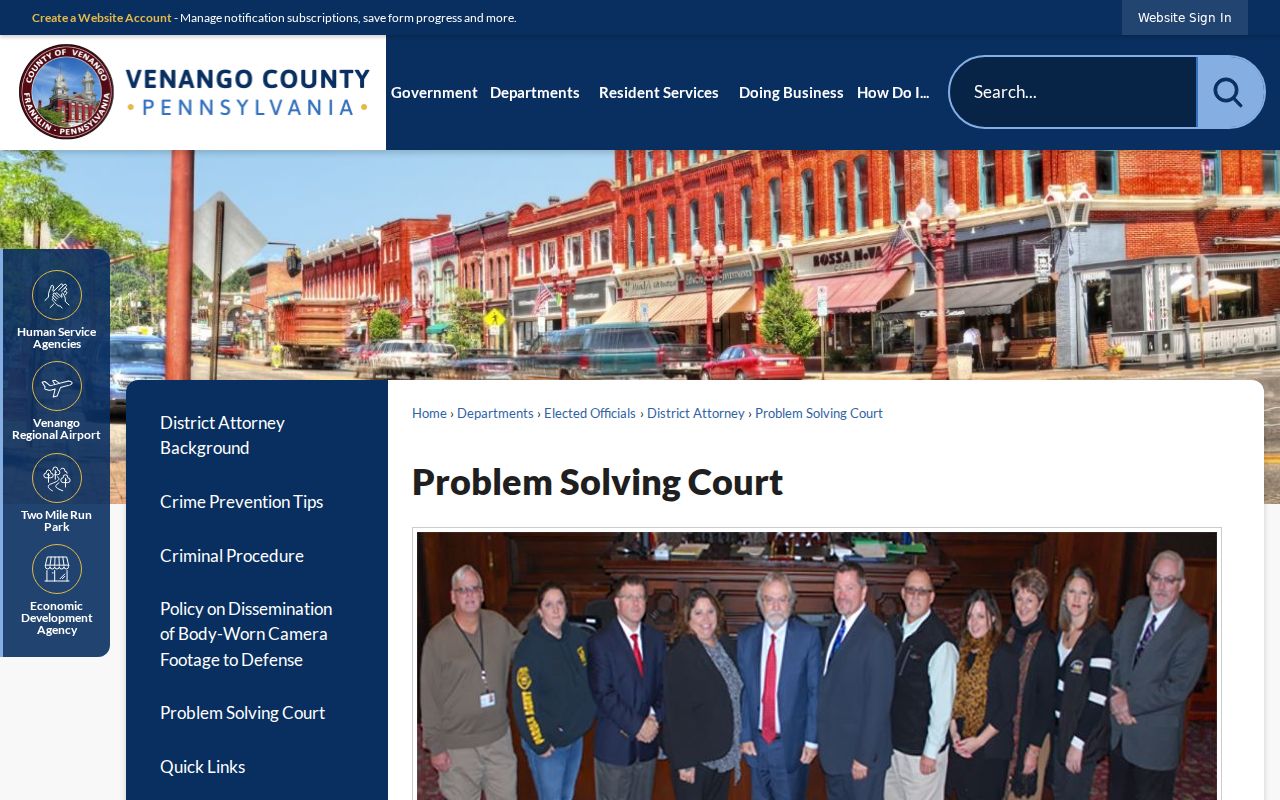
This program layer matters because a docket may show treatment, supervision, or diversion events before a final disposition appears.
Case Record Access & Restrictions
Venango County judicial records follow the UJS Case Records Public Access Policy, not the county's ordinary executive-agency Right-to-Know route. The courts also publish case-information access guidance for online and paper records. Public docket sheets are broadly available, but sealed, expunged, and limited-access matters are suppressed. Protected victim details, financial-account numbers, Social Security numbers, and some information about minors also remain outside public electronic access.
Ask the Clerk or issuing MDJ for case papers, inspection, or certification. The docket is often the index needed to frame that request. The county RTKL officer is not the custodian for a judicial criminal file. If the question instead concerns the police arrest report, direct it to the arresting agency and recognize that investigative material may be exempt under RTKL section 708(b)(16). For the earlier agency and booking trail, consult the county's arrest lookup channels.